 English

 Slovak
 Czech
Czech
 Hungarian
 Italian
 Polish
 Slovenian





Chinese AI causes a stir on Wall Street
In recent years, capital markets have been largely supported by technology stocks, driven by breakthroughs in generative AI, a field dominated by the U.S. The nonprofit organization OpenAI has emerged as a leader, with its flagship product, ChatGPT, featuring advanced language models. Thanks to the AI boom, companies like Nvidia, which provide the necessary hardware infrastructure for AI technology, have seen significant growth. Nvidia has been one of the largest drivers of Wall Street’s recent performance. However, a new app from Chinese startup DeepSeek claims to require much less computing power than models from OpenAI and other giants. If these claims are true, we could be entering a new phase in the trade war between the U.S. and China.
Software companies could benefit from more accessible AI
The release of DeepSeek’s model led to a decline in tech stocks on Wall Street, with Nvidia’s shares hitting several-month lows. On January 27, 2025, the company saw its biggest single-day market value drop in history.* On the other hand, stocks of software companies like Salesforce and Apple rose, with expectations that lower computing costs will facilitate wider AI implementation across industries.* Microsoft, with its cloud platform Azure, could also profit, as it provides an ideal environment for building AI applications.
.png "Nvidia (2)")
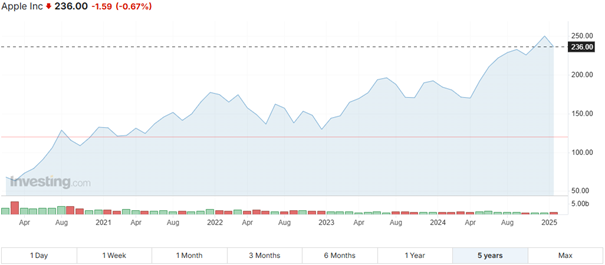
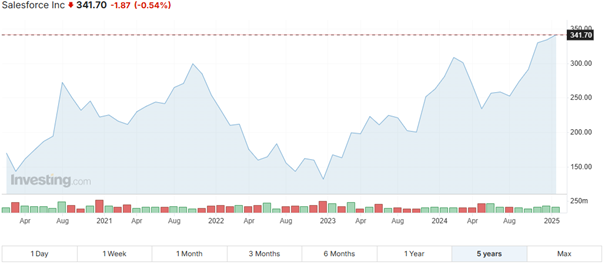
Source: Investing.com*
Microsoft and Nvidia respond to DeepSeek's popularity
Nvidia has announced the availability of the DeepSeek R1 model on its Nvidia Inference Microservice (NIM) platform, currently in preview mode. However, it is expected that the application programming interface for developers will soon be available. R1 is already accessible via Microsoft Azure as well. This shows that tech giants are not wasting time, and despite their investments in billion-dollar data centres for much more expensive models, they must respond to the rapidly growing popularity of DeepSeek in recent weeks.
Breakthrough AI model or a manipulation tool?
According to the analytical company Graphika, the popularity of DeepSeek was not just a result of technological progress but also targeted promotion by Chinese state actors. Official accounts of Chinese diplomats, media, and embassies flooded social media platforms such as X, Facebook, and Instagram with information claiming that Beijing is catching up with the U.S. in AI, they told Reuters. These messages came at a time when investors were already concerned that more efficient Chinese AI models might reduce demand for expensive data centres.
There have also been speculations that DeepSeek may have drawn from technologies developed by OpenAI and other Western companies during its model’s development, but there is no evidence as of now. Canadian investor Kevin O’Leary suggests that the app could be a "Chinese Trojan horse." It appeared right when the U.S. government was meant to ban the use of TikTok by ByteDance, citing concerns over data misuse by the Chinese government. Similar fears have arisen in also in this case with O’Leary noting that it could have relied on illegally smuggled chips, subject to an import embargo in China—a matter that is now being investigated by the U.S. Department of Commerce. Meanwhile, DeepSeek representatives claim that they used legally obtained Nvidia chips from 2023.
Conclusion
If the scenario of Chinese AI’s low hardware demands is true, it could indeed mark a breakthrough moment. This would pose major challenges for companies profiting from advanced semiconductors and AI infrastructures. On the other hand, suspicions about fact manipulation and coordinated efforts by the authoritarian Chinese government are also valid. However, it is clear that the U.S. and China are in a battle for dominance in the tech industry. Therefore, it is crucial to monitor the reactions of Western companies, as well as the administration of Donald Trump, particularly regarding tariffs and embargoes. [1]
* Historical data is not a guarantee of future performance.
[1] Forward-looking statements represent assumptions and current expectations that may not be accurate or are based on current economic conditions that may change. These statements are not guarantees of future performance. Forward-looking statements by their nature involve risk and uncertainty because they relate to future events and circumstances that cannot be predicted and actual developments and results may differ materially from those expressed or implied by any forward-looking statements.
Caution! This marketing material is not and should not be construed as investment advice. Historical data is not a guarantee of future performance. Investing in foreign currencies may affect returns due to fluctuations. All securities transactions may result in both profits and losses. Forward-looking statements represent assumptions and current expectations that may not be accurate or are based on current economic conditions that may change. These statements are not guarantees of future performance. InvestingFox is a trademark of CAPITAL MARKETS, o.c.p., a.s. regulated by the National Bank of Slovakia.
Sources:
https://edition.cnn.com/2025/01/27/tech/deepseek-stocks-ai-china/index.html
https://www.soapcentral.com/shows/this-fact-kevin-o-leary-predicts-future-warfare-ai