 English

 Slovak
 Czech
Czech
 Hungarian
 Italian
 Polish
 Slovenian






Harmonization
Chairman Michel Demare emphasized in an official statement that the new harmonized listing model is primarily intended to support the company’s long-term strategy of sustainable growth and access to global investors. The statement further noted that AstraZeneca remains firmly anchored in the United Kingdom—with its headquarters, tax residency, and primary listings in London and Stockholm. It can therefore be said that the transfer within the United States does not mean an escape from London but rather the company’s effort to expand its international investor base.
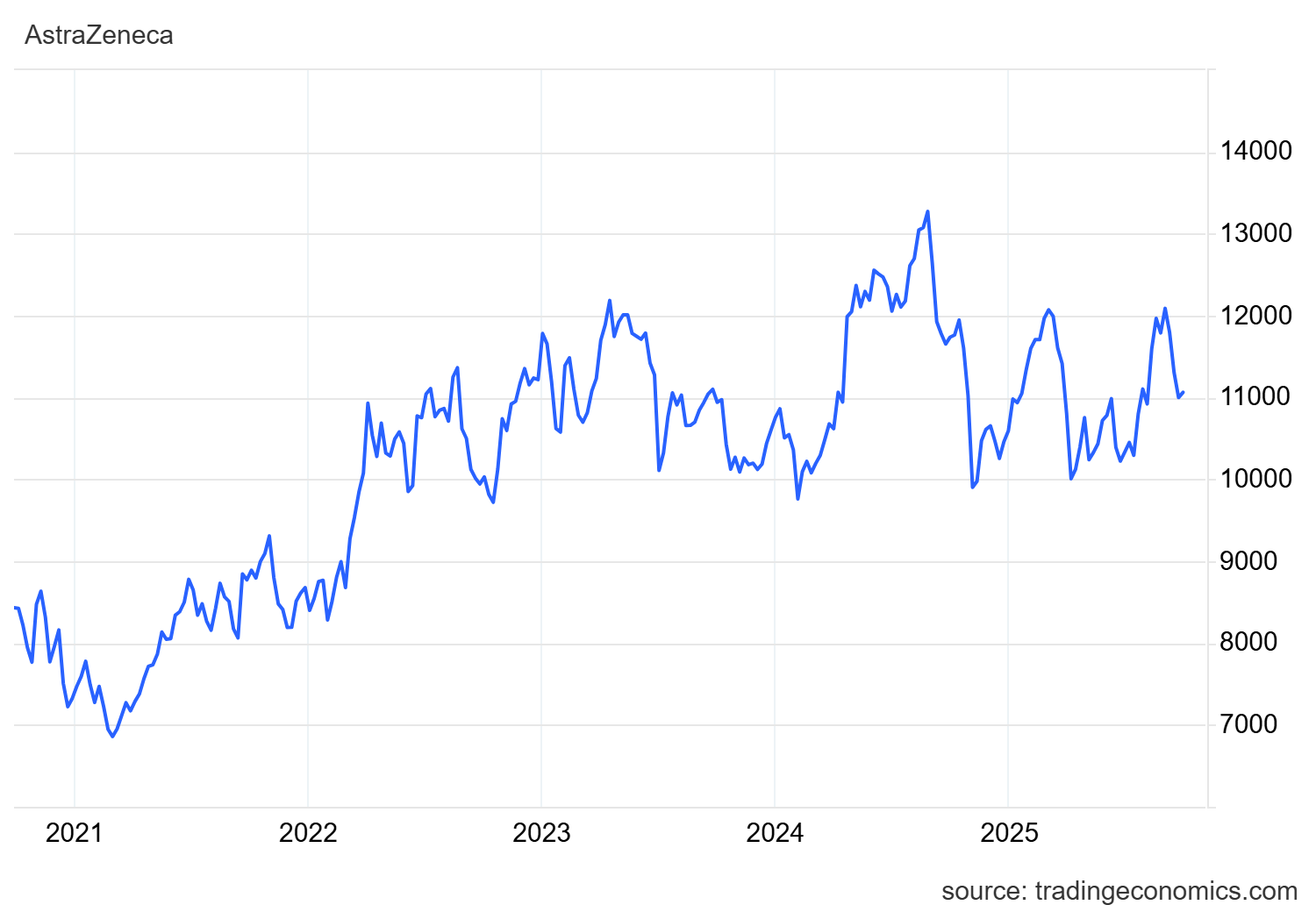
Source: Trading Economics*
London Under Pressure
The moves of major companies, however, evoke a broader trend. In recent years, London has faced a significant outflow of prestigious names—Unilever moved its activities to Amsterdam, while Glencore and Ashtead are considering similar steps. This is why news of a possible departure of AstraZeneca from London was perceived with concern. Based on current information, however, these concerns have been partially alleviated, though it is also clear that competition between stock exchanges is tougher than ever.
Political Dimension
The traditional political pressure from the U.S. is also not negligible. President Donald Trump repeatedly warned pharmaceutical companies that if they do not increase investment and production in the United States, they could face high tariffs. The move to list on the NYSE can therefore also be seen as a diplomatic gesture—a way to stay closer to U.S. investors and regulators without the company losing its European identity.
In addition, at the beginning of September the company decided to cancel its planned £200 million expansion of its research center in Cambridge, which at the same time signals that even in the United Kingdom the business environment is not without problems.
What Comes Next?
From a European investor’s perspective, AstraZeneca’s move to the NYSE is primarily about practical consequences. Expanding access to U.S. capital can support the company’s long-term growth, which may also be reflected in the performance of its shares on the London Stock Exchange. At the same time, however, this step is a reminder that London is no longer an automatic center for global companies, and the competitive pressure from the U.S. and the EU will continue to increase over time.[1]
*Past performance is not a guarantee of future results.
[1] Forward-looking statements represent assumptions and current expectations, which may not be accurate, or are based on the current economic environment, which may change. These statements do not guarantee future performance. By their nature, forward-looking statements involve risk and uncertainty, as they relate to future events and circumstances that cannot be predicted, and actual developments and results may differ materially from those expressed or implied in any forward-looking statements.
Disclaimer! This marketing material is not and must not be understood as investment advice. Past performance is not a guarantee of future results. Investing in foreign currency may affect returns due to fluctuations. All securities transactions may result in both profits and losses. Forward-looking statements represent assumptions and current expectations, which may not be accurate, or are based on the current economic environment, which may change. These statements do not guarantee future performance. CAPITAL MARKETS, o.c.p., a.s. is an entity regulated by the National Bank of Slovakia.
Sources: