 English

 Slovak
 Czech
Czech
 Hungarian
 Italian
 Polish
 Slovenian





Old Friendship, New Business
Behind the partnership are two visionaries who have known each other for three decades – Jensen Huang, CEO of Nvidia, and Lip-Bu Tan, CEO of Intel. Their shared vision was presented following more than a year of negotiations and is divided into two key project lines. Nvidia will become a major customer of Intel’s processors, with the goal of using them in complex artificial intelligence systems for data centers, employed for example by Microsoft.
On the other side, Intel will extensively utilize Nvidia-designed graphics processors in its chips for PCs and laptops, which Huang described as: “An underserved market.” The Nvidia CEO further stated that the value of the addressable markets for both sides of the collaboration is currently $50 billion.
Intel’s Financial Background
The product linkage of these giants also comes with Nvidia’s $5 billion investment into Intel’s common stock. However, it is essential to evaluate Intel’s longer-term situation as well. Over the past five years, the company has struggled with a loss of market value, since its local peak in 2020, Intel’s share price has fallen by more than 50%.*
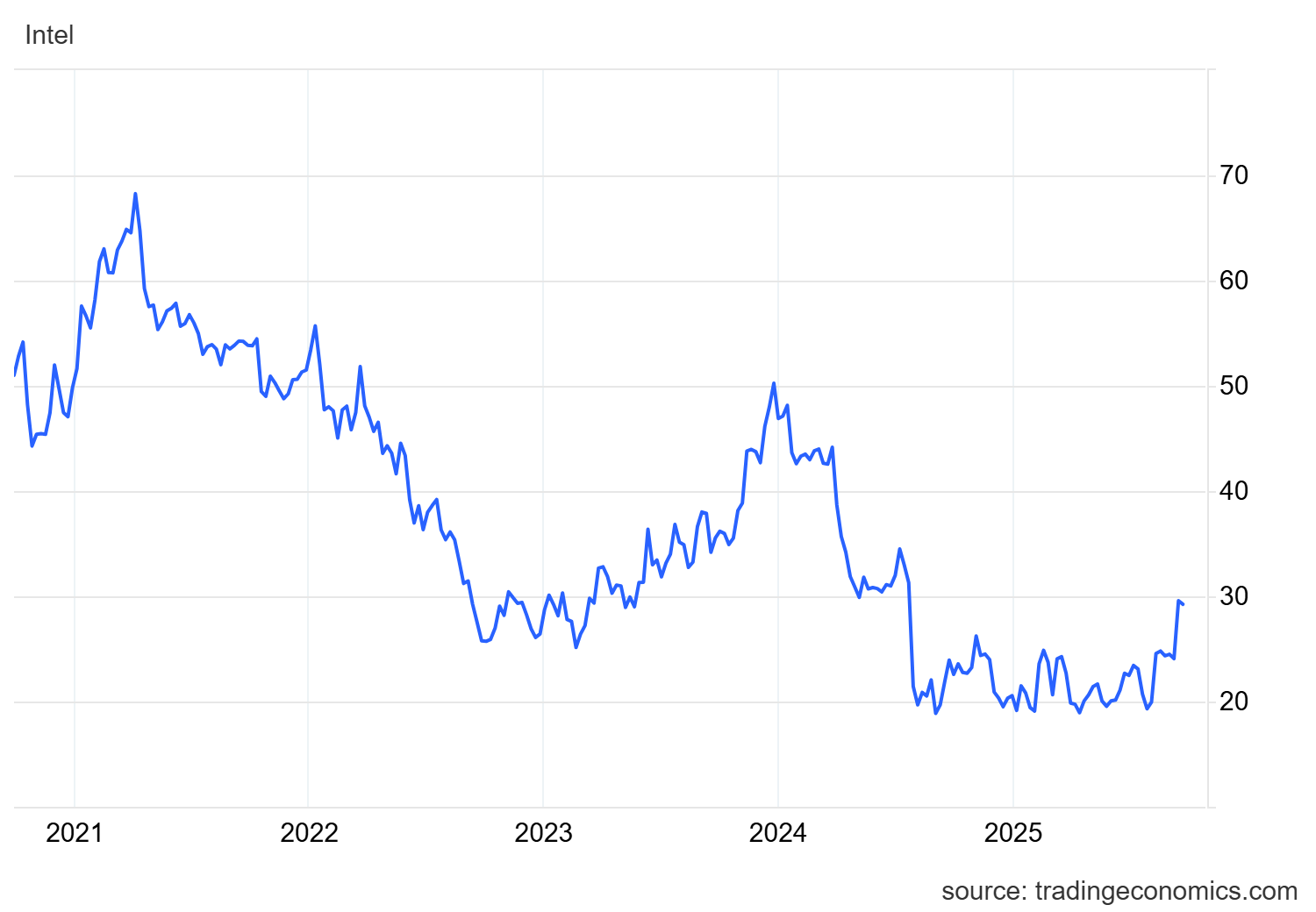
Source: Trading Economics
Intel has been trying to handle the situation with several capital injections. The company received $8.9 billion from the U.S. government under the CHIPS Act program, in return for which Washington acquired a 10% stake. It also accepted an additional $2 billion from SoftBank, and by selling a majority stake in its ASIC subsidiary Altera, Intel collected $3.3 billion from Silver Lake.
Investors are also closely watching the future of Intel Foundry Services. Unfortunately, this division remains uncertain, without a major customer such as Nvidia or Apple, its ambitions will be difficult to fulfill. The United States, however, views Intel as a strategic company capable of producing the most advanced chips domestically.
Conclusion
The joint dynamic between Nvidia and Intel is full of contrasts. On one side stands a company with a market value exceeding $4 trillion, a symbol of the artificial intelligence era. On the other side is the well-known chipmaker seeking a path back to the top. For investors, this ultimately means that Intel is being given a second chance and may represent an interesting opportunity, while Nvidia further consolidates its position in the AI ecosystem. As is often the case in the market, however, success will depend on whether the grand plans can be turned into actual products and profits.[2]
*Past performance data is not a guarantee of future results.
[1,2] Forward-looking statements represent assumptions and current expectations, which may not be accurate, or are based on the current economic environment, which may change. These statements do not guarantee future performance. By their nature, forward-looking statements involve risk and uncertainty, as they relate to future events and circumstances that cannot be predicted, and actual developments and results may differ materially from those expressed or implied in any forward-looking statements.
Disclaimer! This marketing material is not and must not be understood as investment advice. Past performance data is not a guarantee of future results. Investments in foreign currencies may affect returns due to fluctuations. All securities transactions may result in both profits and losses. Forward-looking statements represent assumptions and current expectations, which may not be accurate, or are based on the current economic environment, which may change. These statements do not guarantee future performance. InvestingFox is a trade name of CAPITAL MARKETS, o.c.p., a.s., regulated by the National Bank of Slovakia.
Sources: