 English

 Slovak
 Czech
Czech
 Hungarian
 Italian
 Polish
 Slovenian





New AI models
Baidu saw two promising candidates on the AI model market on Sunday, including the ERNIE X1, the first model to boast an active ability to reason. If all the announced features are confirmed, it would be a direct competitor to the DeepSeek R1, but at an even lower price.
However, the news was not only about new products. Another important step is the transformation of the ERNIE model into an open-source form, effective June 30, 2025. Until now, the company has taken a strict proprietary approach, which as a result has required high investments in the development and subsequent training of models. The transition to an open model will thus allow for a faster shift and at the same time wider adoption of the technology, giving Baidu the potential to adapt more effectively to the dynamic AI market.
Baidu's Competitive Advantages
Despite its slow growth in the AI segment so far, Baidu has other key advantages that can support its future success. The company operates China's largest search engine Baidu Search and the popular online forum Baidu Tieba, thanks to which it has a huge amount of data that can be used to train and improve their AI solutions.
In addition, Baidu CEO Robin Li expects AI to significantly transform the way people search for information online, with their AI search itself potentially becoming a key application of the new digital era.
Risks and challenges
While the giant Baidu shows strong growth potential from a fundamental point of view, it also faces a number of ongoing challenges. Underestimating the dynamics of AI development was one of the main reasons why Baidu fell behind the competition, which means one thing when looking to the future. The company clearly needs to speed up the innovation process.
The second important problem that stood in the way of the company is the fact that the AI sector in China is subject to strict regulations, which have a far-reaching impact on the speed of development, as well as on the scaling of models.
Investment view
From an investment perspective, it can be said that if Baidu manages to use their data sources efficiently, and at the same time accelerate the innovation process in the field of AI, the company can subsequently regain its leading position in the Chinese market. In addition, the change of AI models to open-source indicates a strategic change, with the aim of accelerating the adoption and development of this technology.
While there are risks associated with Baidu, the company has key assets and a strategy that could help it regain a competitive advantage. Last but not least, it is also important to highlight that the share price is in a very advantageous position, given the correction that has lowered valuations to very attractive levels, which may mean a buying opportunity for technology investors to diversify in terms of geographical focus.*
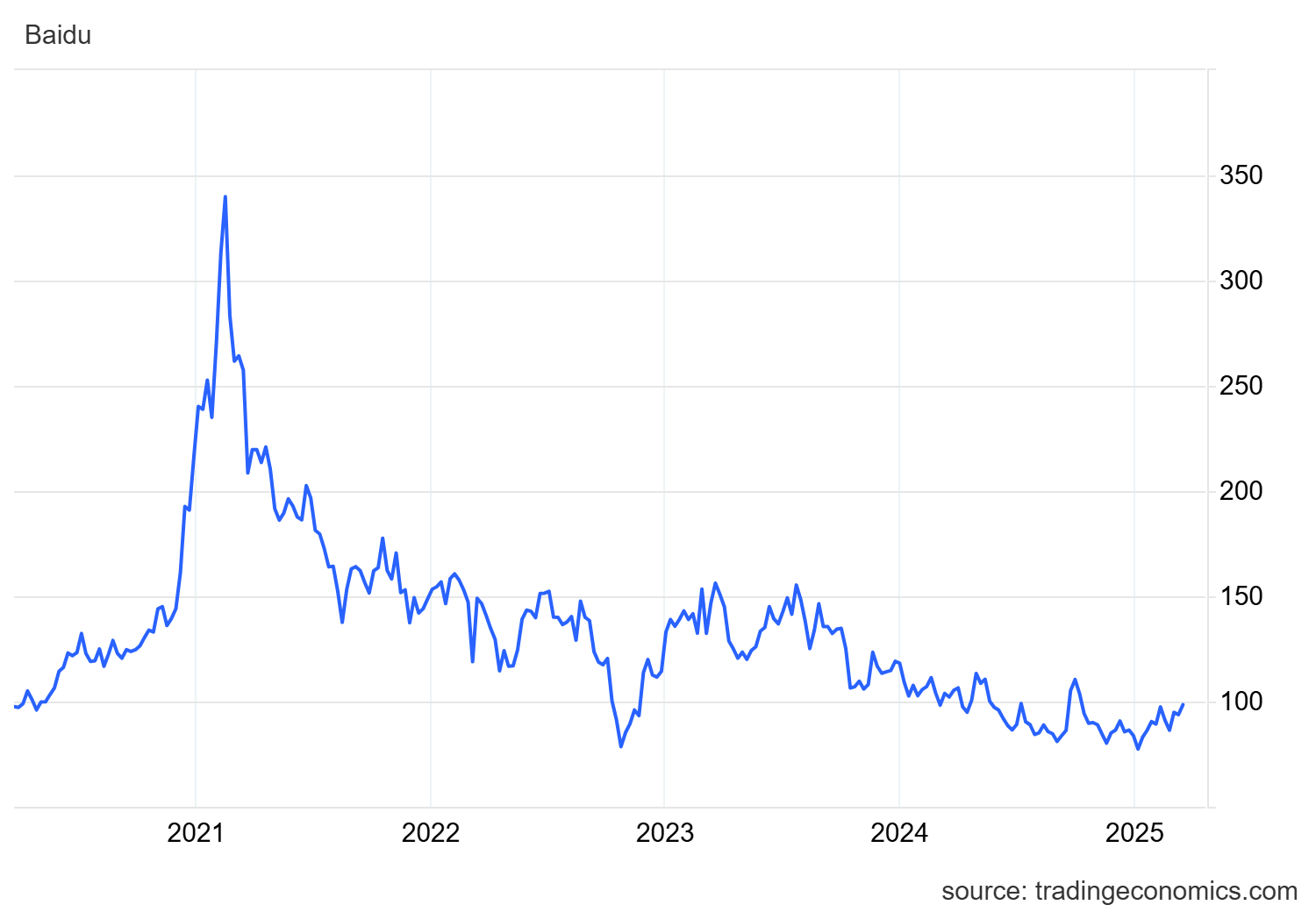
Source: Trading Economics*
* Historical figures are not a guarantee of future returns.
Warning! This marketing material is not and should not be construed as investment advice. Data relating to the past are not a guarantee of future returns. Investing in foreign currency can affect returns due to fluctuations. All securities trades can lead to both profits and losses. Forward-looking statements represent assumptions and current expectations that may not be accurate or are based on the current economic environment, which is subject to change. These statements do not guarantee future performance. InvestingFox is a trademark of CAPITAL MARKETS, o.c.p., a.s., regulated by the National Bank of Slovakia.
Resources: