 English

 Slovak
 Czech
Czech
 Hungarian
 Italian
 Polish
 Slovenian





What brings profit to the company?
The key driver of TSMC's growth in the second quarter has traditionally been the High-Performance Computing (HPC) segment, which includes technologies such as AI and the 5G network in its structure. At the same time, it also grew in total sales. In a year-on-year comparison, the share in the final value of sales increased from 52% to 60%.
A slightly more detailed analysis of the revenue subsequently shows that the strongest component is chips with advanced manufacturing technology of 7nm or smaller, which is understandable as tech giants such as Nvidia, Apple and AMD continue to invest in AI, with Brady Wang, deputy director of Counterpoint Research, expressing the opinion that the demand for AI chips is highly sustainable in the future, as AI as such is still only in its early stages.
Risks and geopolitical challenges
While TSMC's results are remarkable, the company is not without its additional risks. A significant factor influencing its future trajectory is trade tensions between the US and Taiwan. The US under the Trump administration imposed tariffs of 32% on Taiwan, which understandably makes TSMC's export policy unpleasant, but as we have already indicated, the demand from the largest customers is strong enough for now.
An additional aspect to ease the pressure on TSMC is the improving relationship between the US and China. The latest news regarding the resumption of exports of Nvidia and AMD chips to China is also important, as TSMC is a key supplier for both of these companies.
Looking to the future
Investors who are interested in specific prospective numbers for the next period were easily satisfied by TSMC. For the third quarter, the chipmaker expects revenue in the range of $31.8 billion to $33 billion, up 38% from last year and 8% from the previous quarter. Last but not least, TSMC CEO C.C. Wei himself set a full-year sales growth in USD of 30%.
What does this mean for investors?
For investors who already have some exposure to TSMC or are still considering this giant, this company is still a promising candidate for inclusion in the investment portfolio or thus strengthening their existing position. This is based on all the fundamental parameters mentioned above, largely determining the share price, which achieves strong performance against ASML's direct competitor. He expressed a mixed outlook for 2026, which weakened the share price, which is currently from an absolute peak to a correction of 30%, even more. At the same time, however, it is a more advantageous position to buy, as TSMC's share price is currently at the peak of performance.*
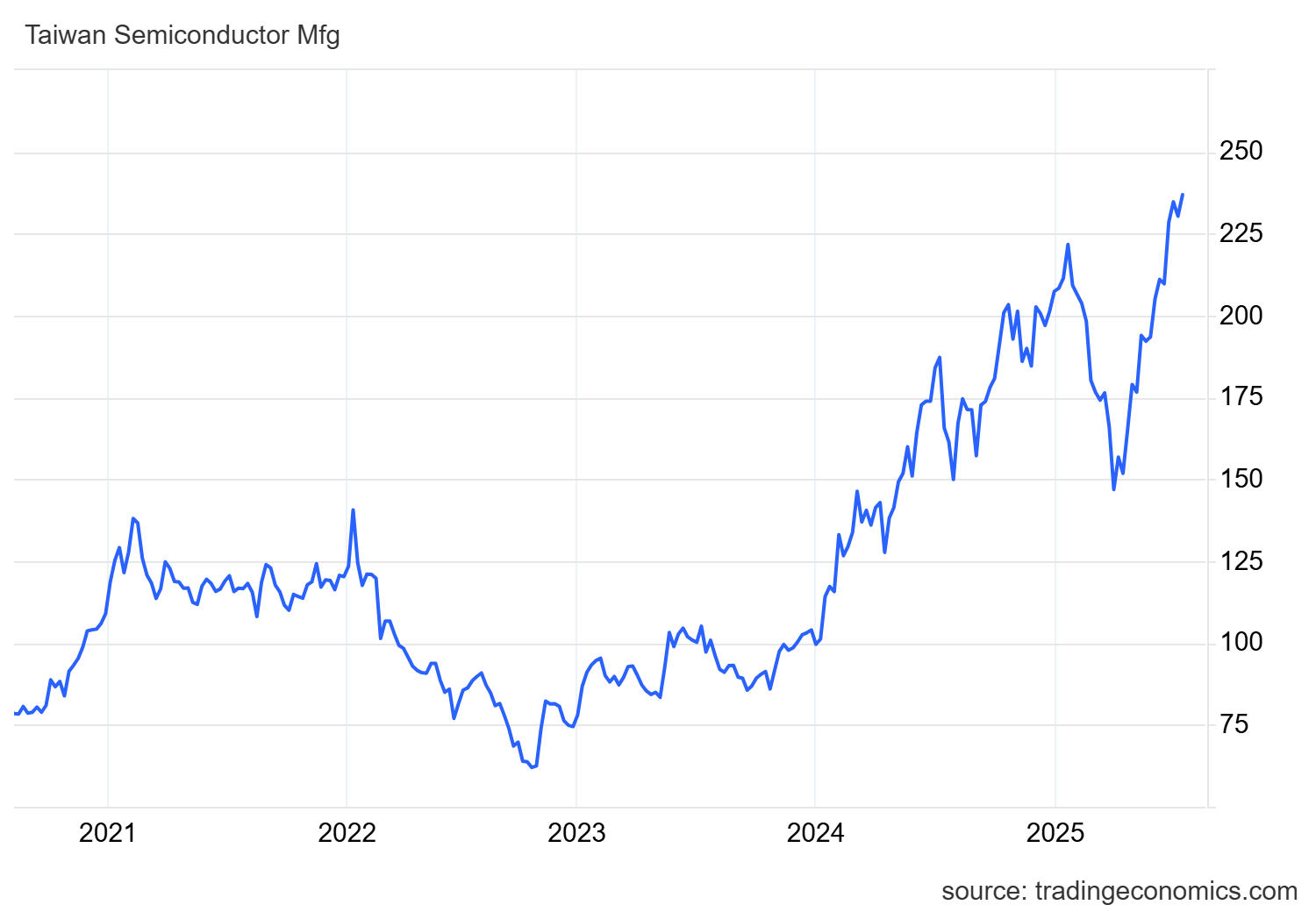
TSMC share price performance over the past five years*
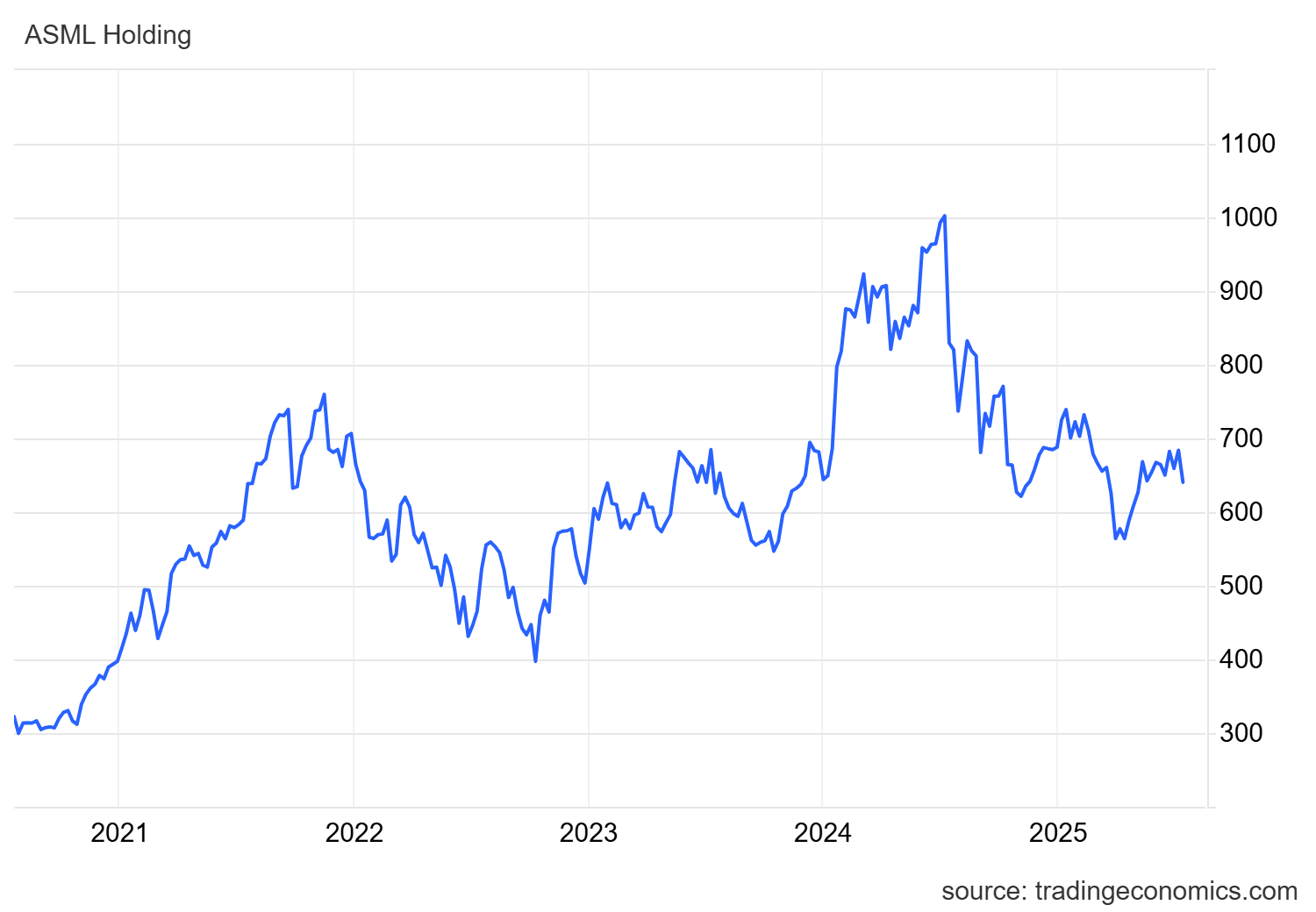
ASML Holding's share price performance over the past five years*
* Historical figures are not a guarantee of future returns.
Warning! This marketing material is not and should not be construed as investment advice. Data relating to the past are not a guarantee of future returns. Investing in foreign currency can affect returns due to fluctuations. All securities trades can lead to both profits and losses. Forward-looking statements represent assumptions and current expectations that may not be accurate or are based on the current economic environment, which is subject to change. These statements do not guarantee future performance. InvestingFox is a trademark of CAPITAL MARKETS, o.c.p., a.s., regulated by the National Bank of Slovakia.
Sources:
https://www.tsmc.com/english/dedicatedFoundry/technology/platform_HPC
https://www.cnbc.com/2025/04/02/trump-tariffs-live-updates.html
https://www.cnbc.com/2025/07/08/trump-threatens-pharmaceutical-tariffs-200.html