
Back to blog

Palantir Under Pressure: Correction and Tension Between Valuations and Market Expectations

The technology sector experienced a noticeable cooldown in November, with Palantir becoming one of the most visible victims of the correction. The company, presenting itself in recent quarters as one of the new leaders in AI infrastructure, saw its stock fall by 16%, marking its worst monthly performance since August 2023. However, this decline was not caused by a deterioration in fundamentals – quite the opposite, Palantir once again exceeded Wall Street’s expectations. So, what triggered the downturn? Palantir Under Pressure: Correction and Tension Between Valuations and Market Expectations
Prices Slow Down

To begin with, it is essential to highlight the general fact that corrections are a natural part of price development in financial markets, and every investor should be fully aware of their potential occurrence. Currently, as suggested in the introduction, the downward movements do not represent any significant drop in the intrinsic value of companies; it is rather a technical correction. Evidence lies in Palantir’s latest quarterly results – the company recorded its second consecutive quarter with revenues exceeding 1 billion dollars.
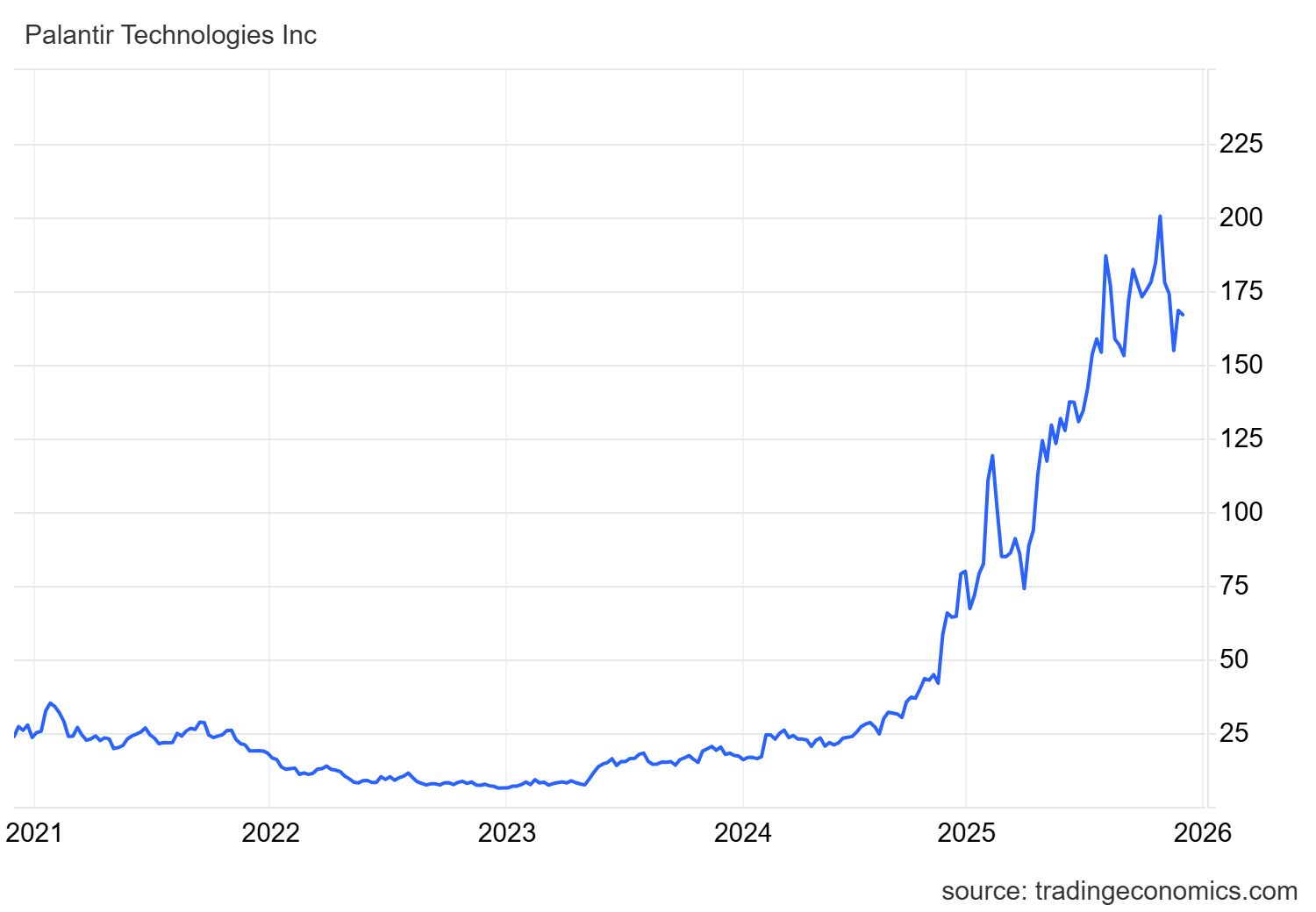
pltr_us

Palantir stock price performance over the last five years*

On the other hand, the situation is also influenced by the traditional profit-taking of investors after a strong year. For comparison, Nvidia saw a decline of 12%, Microsoft by 5%.* The only bright exceptions that remained in positive territory within the Magnificent Seven group in November were Apple and Alphabet.
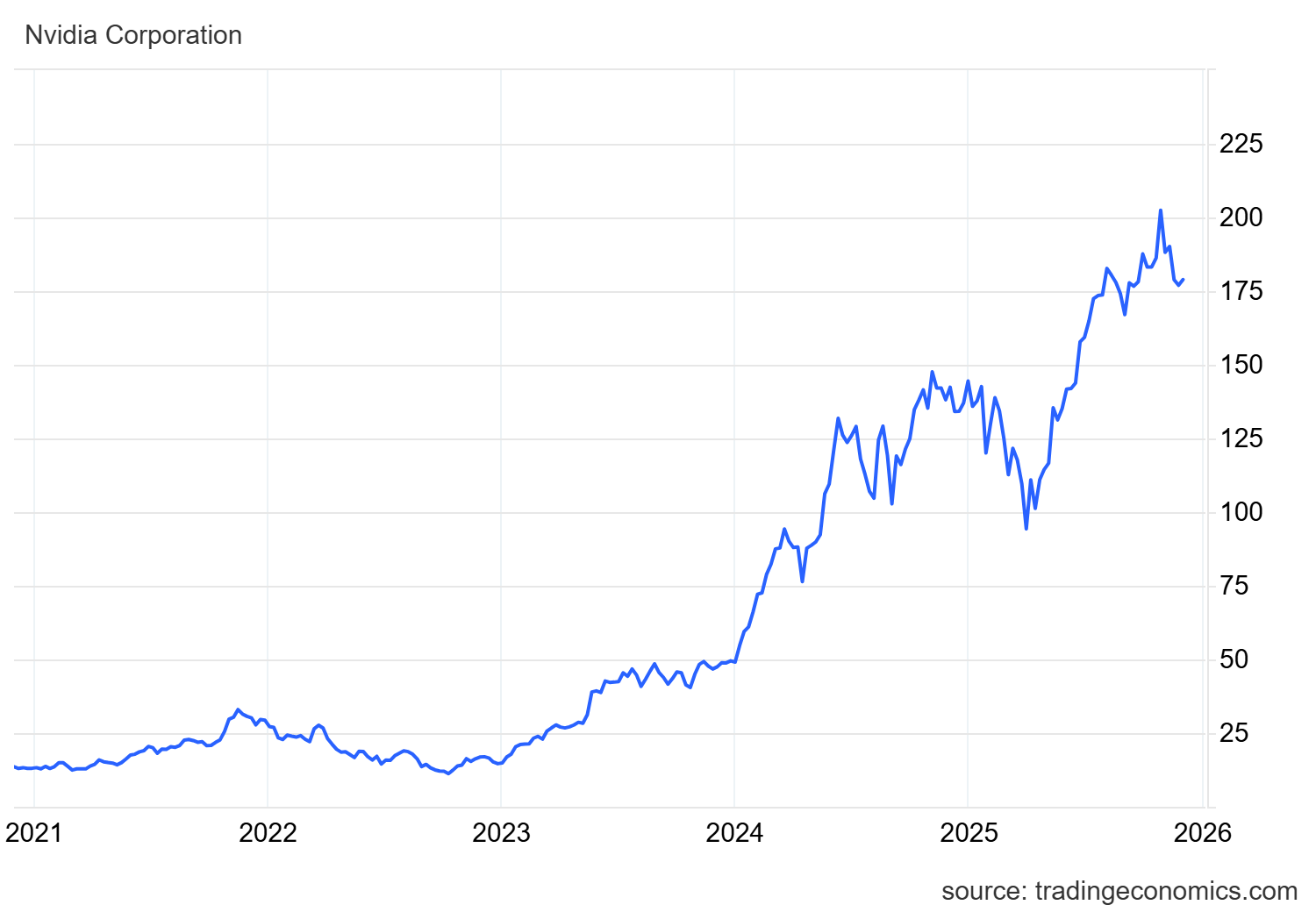
nvda_us

Nvidia stock price performance over the last five years*

msft_us (1)

Microsoft stock price performance over the last five years*

Michael Burry vs. Palantir

The drop in the stock price further intensified the conflict between Palantir and well-known investor Michael Burry. Burry, best known for predicting the 2008 financial crisis, is currently openly betting against both Palantir and Nvidia. He argues that tech giants are artificially inflating profits and that the entire AI sector has unrealistic growth expectations.

Alex Karp, Palantir’s CEO, responded unusually sharply. Within a single week, he appeared on CNBC twice and accused Burry of market manipulation, calling his behavior unfair.

New Contracts and the Future of Palantir

In recent weeks, Palantir has also announced several important partnerships – a multi-year contract with PwC aimed at supporting AI adoption in the United Kingdom, and an agreement with FTAI focused on optimizing aircraft engine maintenance. These deals confirm that Palantir is strengthening its position as a player capable of combining its software, AI solutions, and partnerships with major clients, which is essential given Palantir’s current position.

The key risk for investors remains the company’s high valuation in terms of the price-to-future-earnings ratio, which stands at 233 times. On one hand, this may evoke a premium price, but it is also important to note that the company only recently entered its profitable phase in 2023, making the high level understandable. Therefore, moving forward, attention should be focused primarily on the pace of securing new contracts.

Disclaimer! This marketing material is not and must not be understood as investment advice. Data related to the past are not a guarantee of future returns. Investing in a foreign currency may affect returns due to fluctuations. All securities transactions can lead to both profits and losses. Forward-looking statements represent assumptions and current expectations that may not be accurate or are based on the current economic environment, which may change. These statements do not guarantee future performance. InvestingFox is a trademark of CAPITAL MARKETS, o.c.p., a.s., regulated by the National Bank of Slovakia.

*Data related to the past are not a guarantee of future returns.

Sources:

https://www.cnbc.com/2025/11/28/palantir-ai-selloff-worst-month.html

https://www.cnbc.com/2025/11/03/palantir-pltr-q3-earnings-2025.html
https://www.cnbc.com/2025/11/11/big-short-investor-michael-burry-accuses-ai-hyperscalers-of-artificially-boosting-earnings.html

https://investors.palantir.com/news-details/2025/Palantir-and-PwC-UK-Sign-a-Multi-Year-Multi-Million-Pound-Deal-to-Accelerate-AI-Transformation-as-Preferred-Partners-in-the-UK/

Read more

Nvidia and Amazon are launching a new phase of the AI race: a million chips show where hundreds of billions are headed

Nvidia and Amazon are launching a new phase of the AI race: a million chips show where hundreds of billions are headed

When the biggest players in the tech market stop talking about vision and start reserving physical computing capacity years in advance, the nature of the entire industry changes. Nvidia will supply Amazon’s cloud division with up to 1 million GPU chips by the end of 2027, with deliveries set to begin as early as this year. At first glance, this is just another major corporate deal in AI. In reality, however, this news reveals something more significant.

Ackman Takes on Music Giant: Pershing Square Seeks to Take Control of Universal Music for $64 Billion

Ackman Takes on Music Giant: Pershing Square Seeks to Take Control of Universal Music for $64 Billion

Bill Ackman has once again launched a major capital play, this time in one of the most stable and profitable segments of the media business. His firm, Pershing Square, has submitted a non-binding offer to acquire Universal Music Group valued at approximately €55.75 billion, or about $64.31 billion. The goal is not only the acquisition itself but also to move the company closer to the U.S. market, achieve a higher valuation, and expand its investor base.

Unilever is changing the game: merger with McCormick to create a $65 billion company

Unilever is changing the game: merger with McCormick to create a $65 billion company

Unilever has taken one of its biggest strategic moves in recent years by agreeing to merge its Unilever Foods business with McCormick, creating a global group valued at approximately $65 billion with combined revenues of around $20 billion for fiscal year 2025. For shareholders, this is not just another merger announcement, but a clear signal that Unilever’s management wants to radically restructure the portfolio and shift the company’s focus to faster-growing categories outside of packaged foods. This makes it all the more interesting that the market did not receive this deal with enthusiasm.[1]

Apple and the AI Spring: A Quiet Return of the King?

Apple and the AI Spring: A Quiet Return of the King?

Apple isn’t pushing into AI through the loudest headlines, but through devices that users hold in their hands every day. In early March, it unveiled the iPhone 17e with an A19 chip, 256 GB of base storage, and a price tag of $599, while in the latest quarter, it reported revenue of $143.8 billion, diluted earnings per share of $2.84, and operating cash flow of nearly $54 billion. This is precisely where the essence of the whole topic begins. The company isn’t trying to sell AI as a standalone product, but as a reason to upgrade iPhones more frequently, stay within the ecosystem, and use new features directly in the system, apps, and services.