 English

 Slovak
 Czech
Czech
 Hungarian
 Italian
 Polish
 Slovenian





Strong quarterly growth
Quarterly results are a very complex matter, with companies reporting many important indicators and values, and Microsoft in the third quarter of fiscal 2025 exceeded market expectations on all key fronts. Analysts' consensus was already exceeded with revenue, which increased by as much as 13% year-on-year to $70.1 billion compared to estimates of $68.42 billion. Earnings per share also continued to outperform, reaching $3.46, which is higher than the expected $3.22. However, the highest percentage growth was recorded by net profit, which increased by 18% compared to the same period last year, specifically to USD 25.8 billion.
Cloud and AI as main drivers of growth
Overall, it can be said that all key segments of this giant's business did well, but the biggest star was again the Azure cloud platform, whose revenue grew by 33% year-on-year, of which 16 percentage points came directly from AI solutions. At the same time, Microsoft also provided the traditional Azure growth outlook for the next quarter. For constant currency, growth is expected to be in the range of 34-35%. The Intelligent Cloud division contributed a total of $26.8 billion to total revenues.
In addition to the cloud, other segments also grew. Productivity and Business Processes, which, by the way, include Microsoft 365 commercial products and, for example, LinkedIn, achieved a 10% year-on-year increase in revenue, to $29.9 billion. The More Personal Computing segment, which includes Windows, Search and Xbox, grew 6% year-over-year to $13.4 billion. A positive surprise was also a 75% recovery in sales of Windows 11 commercial licenses, especially in connection with the growth in PC shipments and the approaching end of support for the older version of Windows 10.
Record investments in AI infrastructure
In general, in order for a company to expand, grow in revolutionary areas and thus return value to shareholders, it is logically necessary to have a stable financial situation. Microsoft has been able to maintain this criterion for a long time, and as CNBC reports, CEO Satya Nadella announced that the company plans to invest up to $80 billion in the construction of data centers for AI this fiscal year. Already this quarter, capital expenditures reached $16.75 billion, an increase of 53% year-on-year.
Partnerships, benefits, and technological dominance
Of course, cooperation with OpenAI is also an integral part of the evaluation of Microsoft's quarterly results. According to the latest information from CNBC, their agreement has been modified, where Microsoft has a pre-emptive right to OpenAI's new computing capacity if necessary.
Nadella also commented on the GitHub Copilot assistant, which, according to him, boasts 15 million active users, which is more than 4 times compared to last year.
Market reaction and outlook for the future
Last but not least, we also looked at the development of Microsoft's share price itself, as well as the question of investors whether we will be able to see the continuation of the impulsive growth that took place after the publication of the results, for the next period. From a fundamental point of view, the company provided a positive outlook for the next quarter, so we do not see a reason for a resumption of the bearish correction yet. [1]
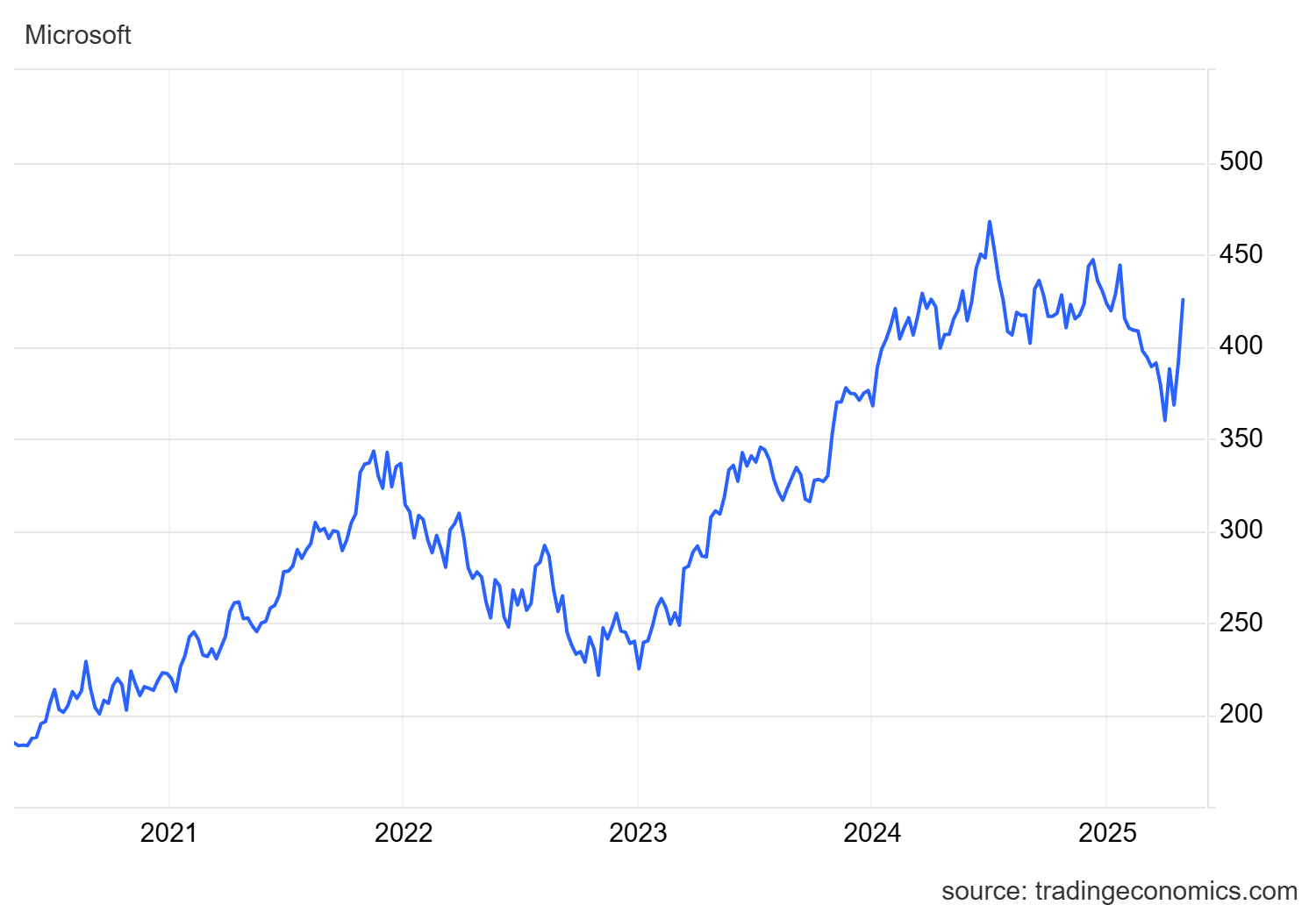
Source: Trading Economics
* Historical figures are not a guarantee of future returns.
[1] Forward-looking statements represent assumptions and current expectations that may not be accurate or are based on the current economic environment, which is subject to change. These statements do not guarantee future performance. Forward-looking statements involve risk and uncertainty by their nature because they relate to future events and circumstances that cannot be foreseen, and actual developments and results may differ materially from those expressed or implied in any forward-looking statements.
Warning! This marketing material is not and should not be construed as investment advice. Data relating to the past are not a guarantee of future returns. Investing in foreign currency can affect returns due to fluctuations. All securities trades can lead to both profits and losses. Forward-looking statements represent assumptions and current expectations that may not be accurate or are based on the current economic environment, which is subject to change. These statements do not guarantee future performance. InvestingFox is a trademark of CAPITAL MARKETS, o.c.p., a.s., regulated by the National Bank of Slovakia.
Resources:
https://www.microsoft.com/en-us/investor/earnings/fy-2025-q3/press-release-webcast
https://www.cnbc.com/2025/04/30/microsoft-msft-q3-earnings-report-2025.html