 English

 Slovak
 Czech
Czech
 Hungarian
 Italian
 Polish
 Slovenian





Record-Breaking Financial Results
In numerical terms, TSMC reported revenue of 839.25 billion TWD, which represents a 41.6% year-on-year growth. This figure means a relatively smooth surpassing of analysts' consensus, who had expected revenue to be 835.13 billion TWD. Of course, this marks a significant shift, but even more impressive was the net profit. It reached 361.56 billion TWD, a year-on-year increase of 60.3%, once again exceeding analysts' expectations of 354.14 billion TWD.
These records were largely driven by revenues from the wafer division, with major contributors being manufacturing technologies at the 7nm level and below. Simply put, all of this points to the sustained demand for the most advanced chips used in artificial intelligence (AI), data centres, smartphones, and other high-tech devices.
Stock Price Development
The story of the stock price development, however, reflects a somewhat more mixed picture. Shortly after the release of quarterly data on April 17, 2025, we observed a slight decline of approximately 1%. By April 22, 2025, the loss had deepened to 816 TWD, with the stock price gradually dropping by 23% since the beginning of 2025.* However, this is part of a broader trend of price corrections on the capital markets, so these discounts can be seen more as an opportunity to buy fundamentally strong companies.[1]
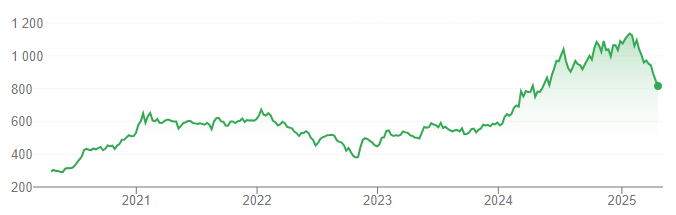
Source: Google Finance*
Trump's Tariffs and Export Restrictions
As mentioned earlier, the major challenge TSMC currently faces is the trade policy of Donald Trump. The base tariff rate of 10% could directly affect the export of chips to the USA, but this is still the better scenario. If a mutual agreement between the USA and Taiwan is not reached within the set 90-day period, the rate could rise to 32%, which is logically even riskier from a financial perspective for TSMC.[2]
In addition to tariffs, there is also talk of expanding the so-called AI diffusion rules, aimed at restricting the export of advanced chips to companies like Nvidia and AMD, which are TSMC's largest customers. These rules thus create additional pressure on the companies and its partners to respond quickly and, above all, efficiently.
TSMC and Investments in the USA
According to current information, the primary response to the mentioned risks in production is strengthening its presence in the USA. The company announced a new investment commitment of 100 billion USD, bringing the total value of its US projects to 165 billion USD. Specifically, this involves building three factories in Arizona to ensure stable chip production for the US market outside of Taiwanese territory.
These initiatives are also part of a broader ecosystem of investments in artificial intelligence, in which up to 500 billion USD is planned to be invested in AI infrastructure, with TSMC being one of the main manufacturing partners.
Long-Term Potential, Short-Term Fluctuations
From an investor's perspective, TSMC represents a fundamentally strong company with a dominant position in the global supply chain for advanced chips. The financial results demonstrate technological excellence and financial strength, while the stock price remains at very attractive levels for new investors or those looking to strengthen their existing positions.[3]
* Past data is not a guarantee of future returns.
[1,2,3] Forward-looking statements are assumptions and current expectations that may not be accurate or are based on the current economic environment, which may change. These statements do not guarantee future performance. Forward-looking statements, by their nature, involve risk and uncertainty because they relate to future events and circumstances that cannot be predicted and actual developments and results may differ materially from those expressed or implied by any forward-looking statements.
Disclaimer! This marketing material is not and should not be construed as investment advice. Past performance data is not a guarantee of future returns. Investing in foreign currency may affect returns due to fluctuations. All securities transactions may result in both gains and losses. Forward-looking statements represent assumptions and current expectations that may not be accurate or are based on the current economic environment, which may change. These statements are not guarantees of future performance. InvestingFox is a trademark of CAPITAL MARKETS, o.c.p., a.s. regulated by the National Bank of Slovakia.
Sources: