 English

 Slovak
 Czech
Czech
 Hungarian
 Italian
 Polish
 Slovenian






UnitedHealth: once the mainstay of the index, today its biggest weakness
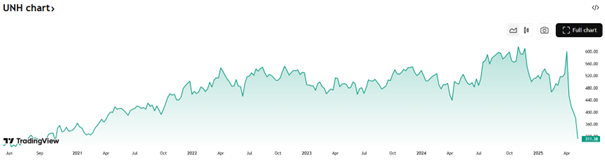
The United States has faced rising health care spending in recent years, but until recently, it didn't bother big players in the sector like UnitedHealth too much. Now the tables have turned. In May, the company cancelled its financial outlook for the full year, citing unexpectedly high costs, especially under the government's Medicare Advantage program. In addition, CEO Andrew Witty announced an abrupt departure, which was another warning sign for the market. The reaction of investors was quick and uncompromising. Stocks plunged nearly 18% on May 14, the sharpest daily decline since 2008. And this is just a few weeks after they faced losses due to poor results for the first quarter of 2025.*
Source: tradingview.com*
The Dow Jones has a structural weakness
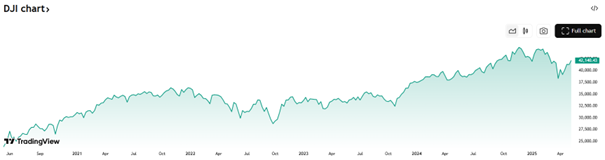
The Dow Jones differs from other major indices in one fundamental way – it weights companies according to the absolute price of their shares, not according to market capitalization. UnitedHealth shares were one of the most expensive in the index, and therefore their sharp decline significantly weakened DJI's point performance. While UnitedHealth accounts for just over 1% of the S&P 500, the company accounted for nearly 9% of its total weight in the Dow before the slump.*
Source: tradingview.com*
Other indices are riding the waves of artificial intelligence
The composition does not help Dow in this situation either. While the tech-savvy Nasdaq and the diversified S&P 500 are benefiting from the stocks such as Nvidia, Super Micro Computer and Palantir, the Dow has only a handful of tech companies – and none of them are the current market drivers. Nvidia rose 5.6% on the same day as UnitedHealth, adding significant positive traction to the S&P 500.* Indices based on market capitalization were thus able to grow despite problems in another sector. The Dow does not have this advantage – it is more conservative, more oriented towards "traditional economy" companies and structurally less prepared for the waves of the technology boom.
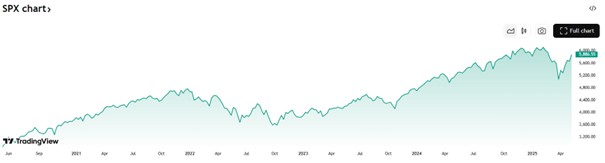
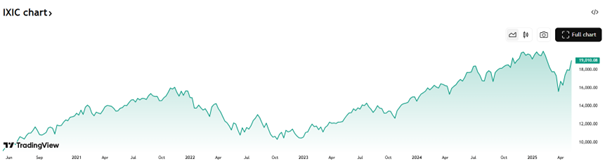
Source: tradingview.com*
Inflation relief and the Fed as a supporting factor
Markets have also been relieved over the past week from a macroeconomic point of view. April's inflation data were favourable, which supported expectations that the Fed will continue to ease monetary policy this year. The markets are currently expecting two rate cuts by the end of this year, with the first one coming as early as September. This improved the overall sentiment, again in favour of Nasdaq and S&P. On the other hand, the Dow Jones did not score too much here either – growth expectations or higher sensitivity to rates play more into the hands of technology stocks than traditional ones.
A trade truce with China? The market reacted cautiously
Investor sentiment was also briefly affected by the announcement of a temporary tariff cut between the US and China – specifically a 90-day postponement of some measures. The news provoked a positive reaction, especially in cyclical sectors and exporters, but the market quickly realized that this was just a tactical gesture, not a systematic reversal in relations between the two economies.
Conclusion
The case with UnitedHealth Group shares shows how much the Dow Jones can suffer when one of its most significant components gets into trouble. The structure of the index is its biggest weakness, and although it is a historically important benchmark, its informative value for today's investor is getting lower and lower. Unlike modern indices, which take into account the true size of companies in the market, Dow Jones is excessively influenced by fluctuations in expensive stocks, which is why it is currently lagging behind. Investors who only follow the "head" of the index can easily overlook what is actually going on under the surface.
* Historical data is not a guarantee of future returns.
Warning! This marketing material is not and should not be construed as investment advice. Historical data is not a guarantee of future returns. Investing in foreign currencies may affect returns due to fluctuations. All securities transactions may result in both profits and losses. Forward-looking statements represent assumptions and current expectations that may not be accurate or are based on the current economic environment, which may change. These statements do not guarantee future performance. InvestingFox is a trademark of CAPITAL MARKETS, o.c.p., a.s. regulated by the National Bank of Slovakia.
Sources:
https://www.investopedia.com/unitedhealth-stock-tumbles-on-ceo-departure-outlook-suspension-11733614
https://extranet.wespath.org/express/WII-Weekly/Weekly-Newsletter-Master.pdf
https://edition.cnn.com/2025/05/13/business/stock-market-dow
Nvidia stock performance over the past 5 years:* https://www.tradingview.com/symbols/NASDAQ-NVDA/?timeframe=60M